
Tutorial 15: Writing the Penetest Report (The Finale)

Lesson notes

Table of Contents
Welcome to Tutorial 15 of the Ethical Hacking & Cybersecurity Masterclass at ONICastro Digital Intelligence. This guide to writing a professional Penetration Testing Report will teach you how to transform technical findings into a business-critical deliverable. The Penetration Testing Report is the most important output of any security assessment.

You have built your lab, performed recon, scanned for vulnerabilities, intercepted web traffic, bypassed authentication, and caught reverse shells.
Now comes the most important phase of a security assessment: Reporting.
Clients do not pay you to hack their systems. Anyone can run an exploit tool. Clients pay you for the report. The Penetration Testing Report is the tangible deliverable of your engagement. If you perform a brilliant, advanced exploit chain but write a poor, unreadable Penetration Testing Report, the client will consider the entire engagement a failure.
A professional Penetration Testing Report must translate complex, technical vulnerabilities into actionable, strategic business decisions for executives, and clear, reproducible remediation steps for IT administrators. Every finding in your Penetration Testing Report should tell a story that drives action.
In this final tutorial, we will analyze the structure of an enterprise-grade Penetration Testing Report and write the findings for the vulnerabilities we exploited throughout this masterclass.
1. The Anatomy of a Professional Penetration Testing Report
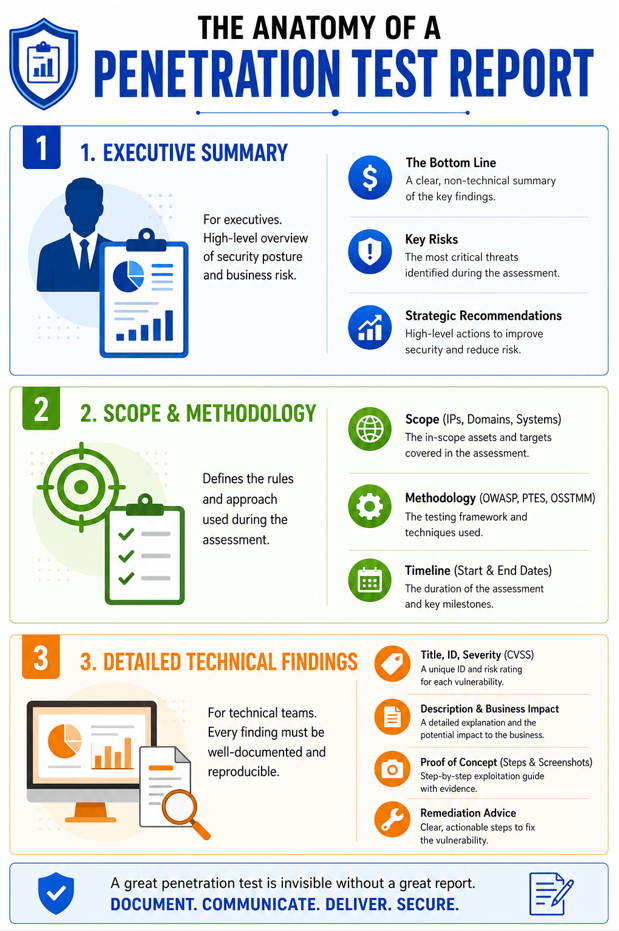
A standard enterprise Penetration Testing Report consists of three main sections. Each serves a distinct audience and purpose.
The Executive Summary
Written for the C-Suite (CEO, CFO, CIO) who do not have technical cybersecurity backgrounds. This section of the Penetration Testing Report must be concise and business-focused.
- The Bottom Line: A non-technical explanation of the target’s overall security posture. Use plain language that a non-technical reader can understand.
- Key Risks: What were the most critical threats discovered (e.g., “Attackers could access employee databases and execute commands on host servers”). Frame these in terms of business impact.
- Strategic Recommendations: Broad fixes, like “Implement a patch management system” or “Train developers in secure coding practices.” These are high-level directives, not technical instructions.
The Executive Summary is often the only section that executives read. Make it count. A well-crafted Penetration Testing Report always leads with a strong Executive Summary.
Scope & Methodology
Clearly defines the rules of engagement. This section of the Penetration Testing Report protects both you and the client.
- Scope: The IP addresses, subdomains, and applications authorized for testing. Be precise and exhaustive.
- Methodology: The testing framework used (e.g., OWASP, OSSTMM, PTES). This demonstrates that your Penetration Testing Report follows industry standards.
- Timeline: The exact start and end dates of the testing. This establishes the temporal boundaries of the assessment.
- Limitations: Any constraints that may have affected testing (e.g., no testing during business hours, specific IPs excluded).
Detailed Technical Findings
Written for the developers and systems administrators who must actually fix the issues. Every single vulnerability documented in the Penetration Testing Report must follow a standardized format. Consistency is key to a professional Penetration Testing Report.
2. Writing a Standardized Finding for a Penetration Testing Report
Every technical finding in your Penetration Testing Report must include the following elements. This standardized format ensures clarity and actionability.
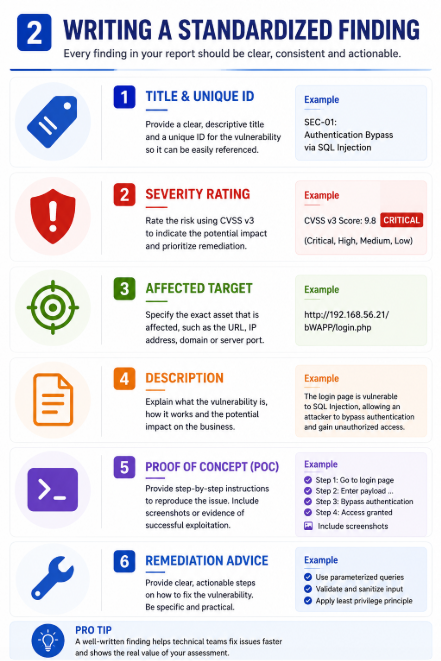
- Title & Unique ID: Clear name of the vulnerability (e.g., “SQL Injection in Login Form” with ID
SEC-01). Unique identifiers allow easy reference throughout the Penetration Testing Report. - Severity Rating: CVSS v3 score (Critical, High, Medium, Low). Use the CVSS calculator to ensure accurate, consistent scoring in every Penetration Testing Report.
- Affected Target: The specific URL, IP address, or server port. Precision is essential so the remediation team knows exactly where to look.
- Description: An explanation of what the vulnerability is and the risk it poses. Describe the technical flaw and the potential business impact in the same section of the Penetration Testing Report.
- Proof of Concept (PoC): Step-by-step instructions showing how you exploited the vulnerability. You must include screenshots showing commands run and access obtained. The PoC is the evidence that makes your Penetration Testing Report credible.
- Remediation Advice: Clear, actionable instructions on how to patch the flaw. Never just say “fix it.” Provide exact configuration changes or code patches. This is the most valuable part of the Penetration Testing Report for the technical team.
CVSS Scoring Quick Reference
Understanding CVSS
Unlock the Remaining 60%
Join the ONICastro Intelligence Hub — completely free.
Get full access to every tutorial and never lose your place.
- Learning Paths synced to your account
- Continue exactly where you stopped
- Completed badges & next recommended step
- Priority access to speedy consultancy


