
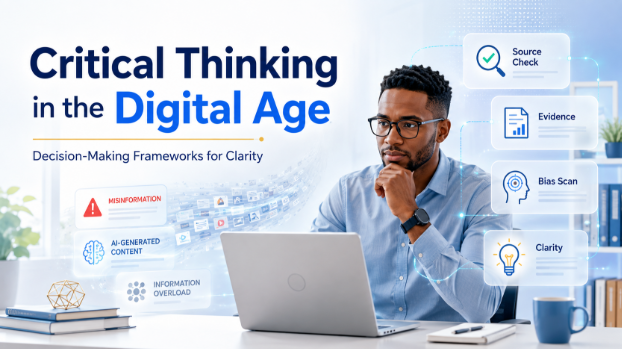
Critical Thinking in the Digital Age: Decision Making Frameworks for Clarity

ToC: Critical Thinking in the Digital Age
The Greatest Threat to Your Mind
What if the greatest threat to your mind isn’t a hackable device, but the constant stream of information you consume without question?
Some years ago, in Lagos, a brilliant young developer I know lost six months’ savings to an investment scheme he found on a WhatsApp group. The pitch was slick. Testimonials, screenshots of bank alerts, a referral system that mimicked multi-level marketing, and an air of urgency. He wasn’t greedy. He was a careful person by nature. But the information environment he operated in had been engineered to bypass his reasoning, not appeal to it. And he had never been taught how to think, only what to think.
That experience sits at the heart of what we do at ONICastro Digital Intelligence. Our core message is: Think clearly. Act securely. Use technology wisely. Clear thinking is the foundation. Without it, every piece of cybersecurity advice, every productivity hack, and every digital transformation strategy crumbles. This article is the first in our MIND series, and we start with the most foundational skill of all: critical thinking in the digital age, rebuilt for a world designed to confuse you.

Why Critical Thinking Is No Longer Optional
We live in an age of manufactured confusion. Sophisticated actors – from state-sponsored disinformation campaigns to Nigerian Yahoo Boys refining social engineering scripts – weaponise information. Meanwhile, generative AI can produce convincing articles, deepfake videos, and fake research papers in seconds. The sheer volume of content doubles every few years, but our cognitive hardware has not been upgraded since we roamed the savannah.
Critical thinking in the digital age, therefore, is not an academic luxury. It is a survival skill. It’s the difference between being a puppet whose strings are pulled by algorithms and becoming an autonomous human being who uses technology without being used by it.
Yet most people misunderstand what critical thinking in the digital age actually requires. They equate it with being cynical, argumentative, or “too smart to be fooled.” Real critical thinking is a disciplined process of actively evaluating information, questioning assumptions (including your own), and adjusting your beliefs in proportion to evidence. It is, as educator John Dewey put it, “reflective thinking” – a willingness to suspend judgment until the ground of your belief is solid. In the digital context, it’s the mental firewall between you and the daily storm of claims. This is what makes critical thinking in the digital age both urgent and transformative.
The Digital Environment Is Not Neutral
To understand why critical thinking in the digital age needs a deliberate upgrade, let’s examine three features of today’s information ecosystem that work directly against clear thought.
1. The Attention Economy Rewards Emotional Contagion
Social platforms and news outlets profit from your outrage, fear, and tribal loyalty. Algorithms amplify content that triggers strong emotional reactions because that drives engagement. A carefully reasoned, nuanced piece with tentative conclusions rarely goes viral. A screaming headline that confirms your deepest bias will find your eyeballs ten times out of ten. In this environment, your emotions are being farmed. Critical thinking in the digital age begins with recognising that the most shareable content is often the least trustworthy.
2. The Illusion of Information Abundance
Having access to all human knowledge in your pocket feels empowering. But information without a framework for processing it isn’t power – it’s noise. Consider the typical Nigerian on Twitter (X) during a breaking news event: a flood of unverified reports, doctored images, partisan spins, and parody accounts mimicking trusted sources. Without active critical filtering, more information leads to more confusion, not more clarity. Information abundance demands information triage, and that requires critical thinking in the digital age as a core competency.
3. The Rise of Synthetic Realities
AI-generated text, images, and voice clones have lowered the cost of manufacturing believable falsehoods to nearly zero. In the recent past, a fake audio clip of a political candidate could require studio expertise. Today, any motivated individual can do it with a free tool. Critical thinking in the digital age now must include a baseline digital literacy that asks not just “Is this claim logical?” but “Could this evidence be synthetically generated? What is the provenance of this content?”
A Working Framework for Digital Critical Thinking
How do you actually practise critical thinking in the digital age when the waves keep coming? I propose a four-stage loop, adapted from classic scientific reasoning and sharpened for the digital context. This isn’t a checklist to perform occasionally; it’s a mental habit to cultivate until it becomes automatic.
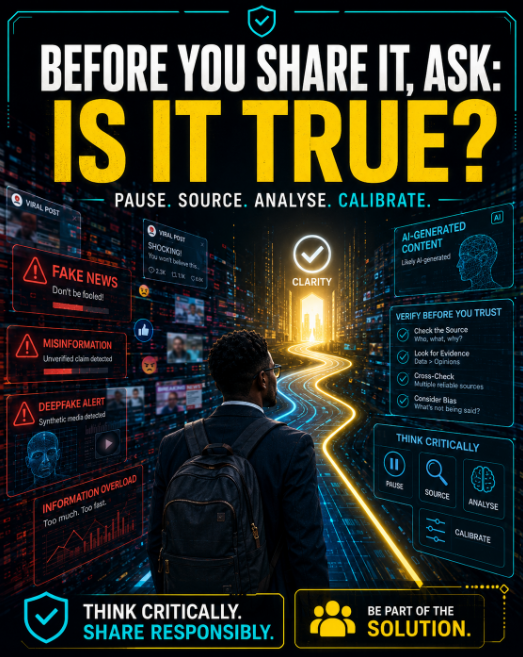
Stage 1: Pause and Identify the Trigger
Before you react to any piece of information – a news alert, a forwarded message on WhatsApp, a viral LinkedIn post – stop. Notice your emotional impulse. Are you feeling anger, fear, excitement, or validation? Those emotions are not an indictment of the content, but they are a signal that your limbic system is being engaged faster than your prefrontal cortex. The simple act of pausing for five seconds disengages the automatic response and opens the door to conscious evaluation. Ask: What is this content trying to make me feel, and why? This pause is the first step toward mastering critical thinking in the digital age.
Stage 2: Interrogate the Source and Structure
Many people attempt to practise critical thinking in the digital age by jumping straight to debating the content. That’s a mistake. First, ask structural questions:
- Who created this, and what is their expertise and motive?
- Who stands to gain if I believe or share this?
- Is this primary information (original data, direct witness) or secondary (someone’s interpretation, a screenshot of a screenshot)?
- Is the source acting within their circle of competence?
In the Nigerian context, learn to identify the marks of engineered misinformation. That WhatsApp broadcast with the MTN logo promising free data? Pause. Did you check the official MTN channels? That screenshot of a “Central Bank memo” circulating on Facebook? Central banks don’t communicate policy via social media graphics. Simple source-verification habits can protect you from 80% of digital deception. These habits are foundational to critical thinking in the digital age.
Stage 3: Analyse the Argument, Not the Wrapper
Now engage with the substance. Separate the factual claims from the opinions and the value judgments. For each factual claim, ask: What evidence would confirm or disconfirm this? Is that evidence publicly available? Has it been replicated? Look for common rhetorical tricks: appeals to emotion instead of evidence, false dichotomies, ad hominem attacks, correlation presented as causation.
A particularly useful mental move is the steel-man technique: restate the argument in its strongest, most charitable form before you evaluate it. If you can’t articulate why a reasonable person might hold the view, you’re not yet ready to critique it. This practice also combats the echo-chamber effect, where we only consume views that comfort us. This analytical depth separates superficial scepticism from genuine critical thinking in the digital age.
Stage 4: Adjust Confidence and Decide
Critical thinking in the digital age isn’t about reaching absolute certainty – that’s rarely possible in a complex world. It’s about calibrating your level of confidence to the quality of evidence. You should be able to think: Based on what I’ve examined, I am 70% confident this claim is true, and I will act accordingly, but I remain open to revision if new data emerges. This epistemic humility is a superpower. It keeps you from becoming over-committed to false positions (a cognitive trap called the “sunk cost fallacy” of belief) while allowing you to take decisive action.

This four-stage loop – Pause, Source, Analyse, Calibrate – is not time-consuming once internalised. It can be performed in seconds. But it requires that you value being accurate over being comfortable, and being truthful over being seen as right. These are the non-negotiable principles of critical thinking in the digital age.
Critical Thinking as a Cybersecurity Asset
At ONICastro, we don’t see critical thinking in the digital age as a separate topic from cybersecurity. They are deeply intertwined. Social engineering attacks – phishing, vishing, business email compromise – exploit the same cognitive shortcuts that fake news does. The “urgent” email from your “CEO” demanding an immediate wire transfer? That weaponises the authority bias and the scarcity effect. The romantic scammer who builds trust over weeks before asking for money? That’s exploiting confirmation bias and emotional reasoning. Every cybersecurity training that simply tells people to “not click suspicious links” without addressing the underlying cognitive vulnerabilities is incomplete. When you train your mind to pause, source-check, and analyse before reacting, you inoculate yourself against a huge swath of digital attacks. This is why critical thinking in the digital age is the first line of defence.
A Practical Exercise to Start Sharpening Your Thinking
Here’s something you can do today, and every day this week. Choose one information source you regularly consume – a Twitter account, a news blog, a WhatsApp group. For each significant claim you encounter, take a sheet of paper or a digital note and write down:
- The claim (paraphrased precisely).
- What emotion it stirred in you.
- The source and its likely motive.
- Whether you could verify the claim from at least two independent, reputable sources within five minutes of searching.
After a week, review your log. Patterns will emerge. You’ll see which sources repeatedly fail the verification test. You’ll notice which emotions make you most susceptible. This simple exercise, practised consistently, rebuilds the attentional muscle that the digital environment seeks to atrophy. It’s a practical application of critical thinking in the digital age that yields immediate results.
Reclaiming the Human Mind in a Machine World
The irony of our time is that we have access to more knowledge than any generation before us, yet we are at risk of becoming intellectually poorer. Not because information is scarce, but because the infrastructure of our attention has been colonised by forces that profit from our confusion. Critical thinking in the digital age is the act of reclaiming sovereignty over your own mind.
This isn’t about becoming a joyless sceptic who trusts nothing. It’s about cultivating what the philosopher Immanuel Kant called the “courage to use your own understanding.” In a Nigerian context, where communal thinking often places high value on deference to authority and group consensus, this courage is radical and necessary. It means you can respect elders, traditions, and shared values while still asking, “How do we know this is true? Is there evidence? What’s the alternative explanation?”
Critical thinking in the digital age needs more than technical skills. It needs a generation of Africans who can think clearly about the information they consume and the decisions they make. That’s why the MIND pillar exists. We’ll walk this path together – through Cognitive Biases Explained, Deep Work Principles, Decision-Making Frameworks, and the other topics in this series. But it all starts here: with a simple commitment to think better, one piece of information at a time.
Because in a world where anyone can make anything up, the clearest signal isn’t louder content. It’s a well-trained mind that practises critical thinking in the digital age every single day.
FAQ Section
What is the simplest definition of critical thinking for everyday use?
It’s the habit of asking, “What’s the evidence for that claim, and how strong is it?” before you accept, share, or act on any piece of information.
Is critical thinking just about finding flaws in what others say?
No. Mature critical thinking is self-directed too. You apply the same scrutiny to your own beliefs, assumptions, and emotional reactions. If you only use it to attack others, you’re doing it wrong.
How is critical thinking different from being negative or sceptical?
Scepticism can mean automatic doubt. Critical thinking is open-minded investigation: it follows evidence wherever it leads, even if it confirms an unpopular position. The goal is accuracy, not cynicism.
How can I avoid information overload while still staying informed?
Curate aggressively. Choose a few high-quality, varied sources with demonstrated track records of accuracy. Use offline reflection time. Consuming less but thinking about it more yields far better understanding than endless scrolling.
Can critical thinking help me spot AI-generated fake content?
Partially. Look for provenance: can you trace the content back to a verifiable original source or human being? AI detection tools help, but they’re not foolproof. Combine technical checks with good old-fashioned source evaluation.
Why do many Nigerian scams still work on educated people?
Education doesn’t automatically confer critical thinking skills. Scammers exploit universal cognitive biases (authority, scarcity, social proof) that bypass book-smarts. Specific critical thinking training, not just academic degrees, reduces vulnerability.
Resources & Tools
Recommended Reading
- Good Reasoning Matters!: A Guide to Critical Thinking in a Digital Age, Sixth Edition – A practical guide to evaluating arguments in the age of AI and social media.
- Thinking, Fast and Slow by Daniel Kahneman – The classic exploration of cognitive biases and their impact on decision-making.
- The Art of Thinking Clearly by Rolf Dobelli – 99 cognitive biases explained in accessible, practical terms.
Digital Tools for Practising Critical Thinking
- Reverse Image Search (Google Images, TinEye): Verify the authenticity of visual content.
- Fact-Checking Platforms: Sites like Africa Check and Dubawa for verifying claims specific to the Nigerian context.
- AI Detection Tools: Tools like GPTZero and Originality.ai to assess whether content is AI-generated.
- News Aggregators: Feedly and Flipboard for curated, multi-source news consumption.
ONICastro Resources
- [INTERNAL LINK: Cognitive Biases Explained] – A deep dive into the mental shortcuts that make us susceptible to misinformation.
- [INTERNAL LINK: Information Overload Management] – Practical systems for filtering and organising information once your critical thinking filter is active.
- [INTERNAL LINK: Cybersecurity Awareness for Everyone] – Connecting the dots between cognitive defences and technical security habits.
- [INTERNAL LINK: Decision-Making Frameworks] – Applying critical thinking to high-stakes professional and personal choices.
Call to Action
Your mind is your primary operating system. Upgrade it deliberately. Critical thinking in the digital age is not optional – it’s essential for navigating today’s information landscape. Join the ONICastro community for weekly insights on cybersecurity, clear thinking, and digital mastery. Subscribe to our newsletter and follow us on social media to get the full MIND series as it releases.
Ready to start thinking clearly? Visit onicastro.ng/contact to learn more about our training programs, consultancy services, and how we can help you and your organisation develop robust critical thinking in the digital age.
Start thinking clearly – start now.
