
Tutorial 12: Wireless Security & Network Interception (MITM Mechanics)

Lesson notes
Welcome to Tutorial 12 of the Ethical Hacking & Cybersecurity Masterclass at ONICastro Digital Intelligence. This guide to Wireless Hacking will teach you how local network protocols can be exploited and how to design defenses that stand up to modern interception techniques. Understanding Wireless Hacking is essential for any security professional responsible for protecting network infrastructure.
So far in this masterclass, we have focused on attacking hosts directly—exploiting web applications and network services. In this tutorial, we shift our focus to the transport medium itself: the local network. This is where Wireless Hacking becomes a critical skill.
When client devices communicate over the air (Wi-Fi) or via a local ethernet switch, they rely on protocol trust models. If an attacker understands the handshake mechanics of wireless security or the resolution protocols of local networks, they can analyze how data flows and identify architectural weaknesses. The field of Wireless Hacking is fundamentally about understanding these trust models and how to exploit them.
We will analyze the theoretical mechanics of the WPA2 4-Way Handshake, the conceptual execution of ARP Cache Poisoning, and—most importantly—the enterprise-grade network defenses required to block these interception vectors entirely. True Wireless Hacking knowledge includes both offensive and defensive perspectives.
1. The Mechanics of WPA2 Security in Wireless Hacking
Most modern corporate and home networks run on Wi-Fi Protected Access 2 (WPA2). To understand how wireless traffic is protected—and how Wireless Hacking techniques bypass it—we must analyze the connection phase: the 4-Way Handshake.
text
   [ Client / Supplicant ]                                    [ Access Point / Authenticator ]
             │                                                              │
             │ ◄─────────────────── 1. ANonce (Random) ─────────────────────│
             │                                                              │
             │ ──────────────────── 2. SNonce + MIC ───────────────────────►│
             │                                                              │
             │ ◄─────────── 3. GTK (Group Temporal Key) + MIC ──────────────│
             │                                                              │
             │ ────────────────────── 4. ACK ──────────────────────────────►│
             ▼                                                              ▼
     (Keys Derived)                                                 (Keys Derived)
The 4-Way Handshake Protocol
When a client (Supplicant) authenticates to an Access Point (Authenticator) using a pre-shared key (PSK), they do not send the password over the air. Instead, they derive temporary encryption keys using a 4-step process. This is the core mechanism that Wireless Hacking targets.

- Message 1: The Access Point sends a random value called the ANonce to the client.
- Message 2: The client generates its own random value (SNonce). It uses these nonces, the password, and MAC addresses to generate a PTK (Pairwise Temporal Key). It sends the SNonce to the Access Point along with a MIC (Message Integrity Code) to prove it knows the password.
- Message 3: The Access Point verifies the MIC, generates the PTK, and sends the GTK (Group Temporal Key) used to decrypt multicast/broadcast traffic.
- Message 4: The client acknowledges the keys, and the connection becomes encrypted.
The Offline Attack Concept in Wireless Hacking
Because the 4-way handshake contains all the cryptographic variables needed to verify if a password is correct, capturing these four packets allows an auditor to perform an offline dictionary attack. This is the foundational concept behind Wireless Hacking against WPA2.
By capturing the handshake in a packet capture file (PCAP) and passing it to a cracking utility alongside a wordlist, the utility computes the mathematical key derivation process for each word in the list until it finds a matching MIC. Because this calculation happens locally on the auditor’s computer, the target network remains completely unaware of the brute-force attempt. This makes Wireless Hacking a stealthy and effective approach.
Deauthentication Attacks
A key technique in Wireless Hacking is the deauthentication attack. To capture the 4-way handshake, you need a client to connect or reconnect. By sending forged deauthentication frames to a connected client, you force them to disconnect and automatically reconnect, triggering a new handshake that you can capture. This is a staple of practical Wireless Hacking.
2. ARP Cache Poisoning Theory for Wireless Hacking
Once inside a local network (whether wired or wireless), devices must route packets to the default gateway (the router) to access the internet. As established in Tutorial 3, this relies on the Address Resolution Protocol (ARP). This protocol vulnerability is a key target in Wireless Hacking.
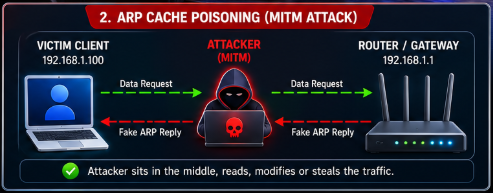
Because ARP is stateless and lacks authentication, it
Unlock the Remaining 60%
Join the ONICastro Intelligence Hub — completely free.
Get full access to every tutorial and never lose your place.
- Learning Paths synced to your account
- Continue exactly where you stopped
- Completed badges & next recommended step
- Priority access to speedy consultancy